
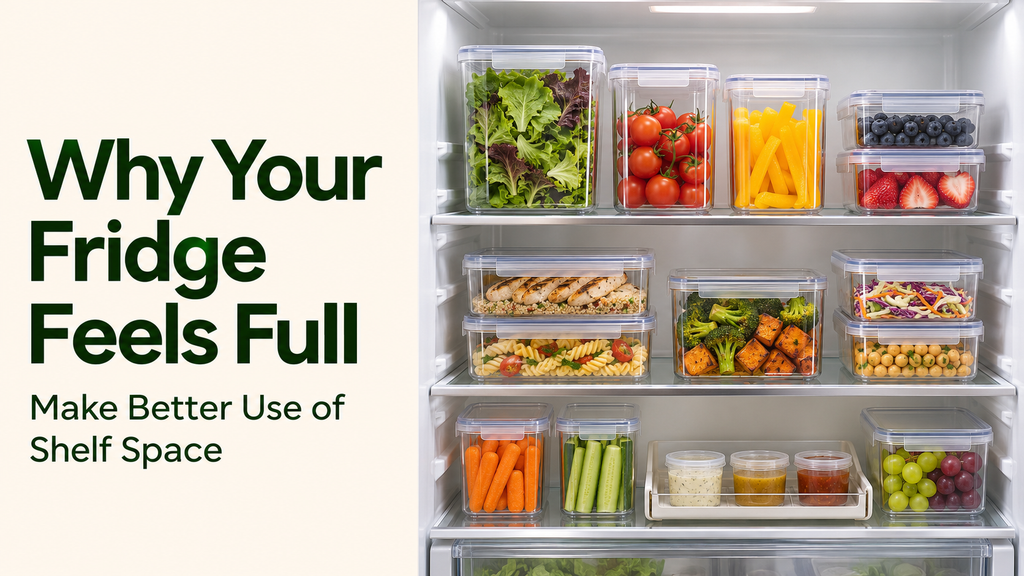
You open the fridge with a container of leftovers in hand. There’s a gap behind the front row and space above two shallow tubs, yet the container you’re holding fits in neither place. Before buying another organizer, take a look at where the gaps are, what shape they are, and whether you can reach them without moving everything in front.
Measure the shelf you use most
Start with the shelf where you usually put leftovers or weekday lunches. Take out the containers and measure the shelf’s usable width, depth, and height. Compare those dimensions with the outside dimensions of your containers with the lids on, including any handles or latches that stick out.
If you want to stack two shallow containers, measure them as a stack. Slide them onto the shelf and pull them out again. Leave enough clearance to grip the top one, and put the lunch you’ll eat first on top. That small change can make the space above a short container usable without making lunch harder to reach.
Match the container to the food you have left
A large container that held a batch of roasted vegetables on Sunday still occupies the same space when it holds a single serving on Tuesday. When you’re already portioning out a meal, move that last serving to a smaller container and place it near the front. The larger one is free for the next batch, and the leftovers are easier to spot.
Use the portions you routinely store to choose your sizes. Try a shallow container for lunch, a deeper one for several servings, and small tubs for dressings, sides, or the last portion of dinner. Fill each with food you actually make before deciding which size deserves more space in your fridge.
Make the back row easy to reach
A deep shelf can hide small containers behind larger ones. Group small tubs you use together in a shallow tray you can pull forward. Check that the tray clears the shelf edge and that you can remove it without shifting the containers next to it.
Straight-sided boxes can line up side by side to make a clear row. If you already have round tubs, group them in one spot for foods you tend to store in them. Give tomorrow’s lunch and leftovers you plan to eat first a visible spot at the front.
What retail buyers can test in a food storage set
If you’re developing a private-label food storage set, run three tasks with samples: pack one lunch, put away the leftovers from a family dinner, and portion out a few sides or dressings. Try the containers on shelves of different heights, measure the space occupied by the filled set, and check whether individual boxes are easy to retrieve.
If two bases are designed to share a lid, try it on both. Check whether it seats evenly and whether the latches close with a similar feel. The trial can help you choose which sizes to launch together, how many lids the set should include, and what to show on the packaging.
HOMESMART works with retail and e-commerce teams on container sizes, lid designs, and custom packaging. Explore HOMESMART’s food storage solutions.